Submission
ACLing 2026 · Author Information
Paper Submission
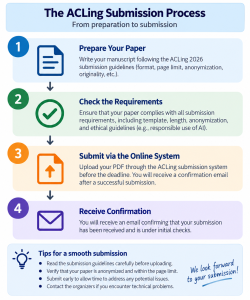
Prepare your manuscript, check the submission requirements, and submit your paper through EasyChair.
Official Submission Templates
Microsoft Word · Preferred
Use the updated ACLing 2026 Word template.
LaTeX
Use the updated ACLing 2026 LaTeX template.
Preserve the supplied formatting. Templates from ACL, EMNLP, COLING, or other conferences are not accepted.
General Guidelines
To ensure consistency and maintain the quality of the conference proceedings, all submissions to ACLing 2026 must adhere to the submission and formatting requirements outlined below. Authors are strongly encouraged to carefully verify compliance before submission. Under the ACLing rolling review process, authors may, where appropriate and feasible, be given an opportunity to correct minor and readily resolvable submission issues. Substantial violations of the submission requirements, however, may result in the manuscript being excluded from the review process.
- Language of Papers and Presentations: Papers must be written clearly in English, and conference presentations must be delivered in English. This requirement applies to how the research is communicated. Research on any natural language—including Arabic—is welcome, provided it falls within the conference’s scope. Multilingual and cross-lingual research is also welcome.
- Anonymization: Initial submissions must be fully anonymized. Authors should remove all identifying information, including names, affiliations, email addresses, acknowledgments, and self-citations that could reveal identity.
- Format: Submissions must follow the official ACLing conference single-column format. Authors may use either the Microsoft Word template (preferred) or the LaTeX template, both of which are provided below.
- Template Compliance: Authors are strictly advised not to modify the formatting templates. This includes paper dimensions, margin widths, font sizes, and spacing, as doing so may result in automatic rejection.
- Do Not Use Other Conference Templates: Templates designed for other conferences (e.g., ACL, EMNLP, COLING) are not acceptable.
- Further Guidance: For detailed instructions and answers to common formatting questions, please refer to the Document Preparation FAQ Download FAQ by Elsevier.
Submission Templates for ACLing 2026
To ensure proper formatting and seamless integration into the conference proceedings, authors are required to use the updated official ACLing 2026 submission templates. Templates are available in both Microsoft Word and LaTeX formats:
- MS Word Template (Preferred): Download Word Template
Recommended for most authors, this template ensures compatibility with the final publication format and simplifies document preparation.
- Latex Template: Download LaTeX Template
Suitable for authors familiar with LaTeX, this template adheres to the ACLing 2026 formatting requirements.
Please ensure that your submission strictly follows the template guidelines to avoid desk rejection. If you encounter any technical issues, contact the organizing committee for support.
Initial Submission Requirements
Authors intending to submit to ACLing 2026 must adhere to the following guidelines to ensure their papers are eligible for review and publication:
- Originality, Authorship, and Responsible Use of AI: Submissions must present original, unpublished research and must not be under consideration at another conference or journal. Authors are fully responsible for the originality, accuracy, validity, and integrity of all submitted content, including any material developed with the assistance of generative AI tools. AI-assisted content must be critically reviewed and verified by the authors; fabricated or unverifiable references, data, results, or other scholarly content are not acceptable.
- Paper Type: Submitted manuscripts should be structured as technical papers, presenting clear research questions, methodology, experiments (if applicable), and conclusions.
- Review Policy Compliance: All submissions must comply with ACLing’s double-blind review policy and the multiple submission guidelines (see details below). Papers that violate these policies will be automatically rejected.
- Length Requirements: Manuscripts must not exceed 8 pages, including all figures, tables, and references..
- Authors may extend their papers by up to 2 additional pages, subject to an extra page charge View Registration Fees.
- Timeliness and Format: Late submissions or manuscripts that do not conform to the required format or structure may be excluded from the review process.
- Full Paper Requirement: The conference does not accept abstract-only submissions. A complete paper is required for review and consideration.
- Presentation Commitment: Submission implies a commitment that at least one author will register for the conference and present the paper if accepted (see the Presentation Requirements section).
- Electronic Submission Platform: Submit via EasyChair
Scientific Quality and Submission Readiness
ACLing welcomes high-quality contributions in computational linguistics, NLP, and interdisciplinary language-model applications. Applied submissions should explain the language model’s central role, identify the research contribution, and provide evaluation appropriate to the claims. Research may address any natural language, including Arabic, as well as multilingual and cross-lingual settings.
A submission should provide sufficient information for reviewers to understand and assess the work, including a clearly defined research problem, appropriate methodology, adequately described data and experimental settings, meaningful evaluation, and conclusions supported by the reported results. Where applicable, experiments should be sufficiently complete to substantiate the paper’s main claims, and important methodological and implementation details should be documented to support transparency and reproducibility.
Authors are also responsible for carefully verifying the accuracy and integrity of all submitted content. References should correspond to genuine and relevant scholarly sources, reported results should be traceable to the experiments described in the paper, and datasets, figures, tables, and citations should be checked for accuracy and consistency.
The use of generative AI tools for appropriate research or writing support does not replace the authors’ responsibility for the scientific content of the manuscript. Authors remain fully accountable for the originality, accuracy, validity, and integrity of their submission. AI-generated or AI-assisted content must therefore be critically reviewed and verified by the authors. Fabricated or unverifiable references, results, data, experiments, or other scholarly content are not acceptable.
Submissions with substantial scientific or integrity concerns—such as materially incomplete experiments, insufficient methodological information to assess the work, unsupported claims, fabricated or unverifiable content, or significant violations of the submission requirements—may be considered unsuitable for review or publication.
These expectations are intended to maintain the quality and integrity of ACLing proceedings while supporting a fair, transparent, and constructive review process for all authors.
Extended Journal Publication Opportunity
Authors of accepted ACLing 2026 papers may also have the opportunity to prepare a substantially extended version of their conference paper for submission to Computation (MDPI). The journal is indexed in Web of Science and Scopus, and a special APC discount will be available for ACLing authors. View Extended Journal Publication Details in the Call for papers page
The ACLing Review Model
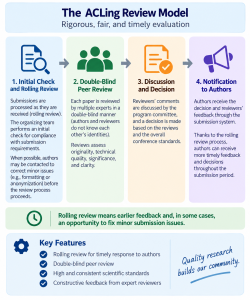
ACLing 2026 follows a rigorous peer-review process designed to ensure the highest standards of scientific quality and scholarly integrity. The conference employs a double-blind review model to minimize potential biases related to author identity, institutional affiliation, or prior recognition.
Rolling Review and Timely Decisions
ACLing 2026 reviews submissions as they are received, rather than waiting until the submission deadline. This rolling review process is intended to provide authors with prompt feedback and decisions. Authors are encouraged to submit early; all papers follow the same scientific standards and double-blind review process.
During the initial submission checks, authors may, where appropriate and feasible, be given a limited opportunity to correct minor administrative or formatting issues before the paper proceeds further in the review process.
This opportunity does not allow authors to complete unfinished research or substantially revise the scientific content after submission. Incomplete experiments, unsupported claims, significant methodological deficiencies, originality concerns, and research-integrity violations remain subject to the conference’s normal review and decision procedures.
Double-Blind Review Policy
To preserve the integrity of the review process:
- Submissions must not include author names, affiliations, or contact information.
- Authors must avoid self-references that could reveal their identity. For example, instead of writing “We previously showed (Smith, 1991),” use “Smith (1991) previously showed…”.
- Acknowledgments, including funding sources, institutional support, or technical assistance, must be omitted from the initial submission.
- Papers should not include links to external supplemental materials that could identify the authors.
- Authors will be required to provide full identification details during the EasyChair submission process, but these details will remain hidden from reviewers.
Multiple Submission Policy
ACLing 2026 enforces a strict policy regarding originality and overlap:
- Submissions must be original and must not be under review at any other conference or journal at the time of submission.
- Manuscripts must not significantly overlap (i.e., more than 20%) with other papers submitted by the same authors to ACLing 2026 or any other venue.
- Violations of this policy may result in immediate rejection of all related submissions.
Camera-Ready Requirements
Authors of accepted papers must prepare and submit a final, camera-ready version that strictly adheres to the following guidelines to ensure inclusion in the ACLing 2026 conference proceedings, published by Elsevier Procedia Computer Science.
- Page Limit: Final manuscripts must not exceed 8 pages, inclusive of all figures, tables, and references.
- Up to 2 additional pages may be included for an additional charge per page (see the View Registration Fees Section).
- Deadline Policy: The camera-ready submission deadline is final and non-negotiable.
- Papers received after the deadline will not be published, and registration fees will not be refunded.
- File Format: Final submissions must include the PDF and editable source files, prepared using the official ACLing 2026 Word or LaTeX template (see Submission Templates section).
- The name of the corresponding author must be clearly indicated in the manuscript.
Steps for Camera-Ready Submission
- Revise Your Paper: Carefully address all reviewer comments and incorporate the suggested revisions into your final version..
- Follow Publisher Guidelines: View Elsevier’s official Guide for Authors
- Ensure that your manuscript strictly adheres to the formatting requirements. Do not alter style files, margins, font sizes, or paper dimensions.
- Prepare Submission Files: Submit a compressed ZIP file containing:
- The final PDF version of the paper.
- The editable source files (MS Word or LaTeX).
- Use the following naming convention:
- compressed ZIP file name:
ACLing2026_PaperNumber.zip - final PDF version name:
ACLing2026_PaperNumber.pdf - editable source files name:
ACLing2026_PaperNumber.docx or .tex
- compressed ZIP file name:
- Submit via EasyChair: Upload your ZIP file to the EasyChair platform under your original submission.
- Author Registration: Ensure that at least one author is fully registered for each accepted paper by 15 November 2026. Failure to register by this deadline will result in exclusion from the proceedings.
Copyright Information
Elsevier uses an automated system for copyright and license transfer. Authors will receive the exclusive license form directly via email during the production stage. Timely completion of this form is mandatory for publication.
Presentation Requirements
All accepted papers must be presented at the conference in order to be included in the published proceedings. At least one author per accepted paper must register for ACLing 2026 and attend the conference (in person or virtually) to present the work.
We look forward to your contributions and to a dynamic exchange of ideas at ACLing 2026.
Conference Contacts
- Khaled Shaalan: khaled.shaalan
@buid.ac.ae - Samhaa R. El-Beltagy: samhaa@computer.org
- Taher M. Ghazal: taher.ghazal@ieee.org
General Inquiries
- General Contact: acling2026@gmail.com